



How 360-Degree Dashcam Systems Improve Fleet Safety, Driver Safety, and Road Accident Evidence
Road safety is a major concern for transport companies, logistics operators, and commercial vehicle owners. Every day, trucks, buses, and delivery vehicles travel through busy highways, narrow roads, crowded cities, and industrial areas.For drivers, one of the biggest challenges is seeing everything happening around a large vehicle.
Traditional rearview mirrors are useful, but they cannot show every area. A motorcycle may travel close to a truck’s side, a pedestrian may stand behind a bus, or another vehicle may enter a blind spot during a turn.These situations can lead to serious accidents.
A 360-degree dashcam system helps improve visibility by using multiple cameras to monitor the surroundings of a vehicle. It can also record important video footage that may help explain what happened during a road accident.Let’s understand how this technology works and why it is becoming valuable for commercial fleet safety.
What Is a 360-Degree Dashcam System?
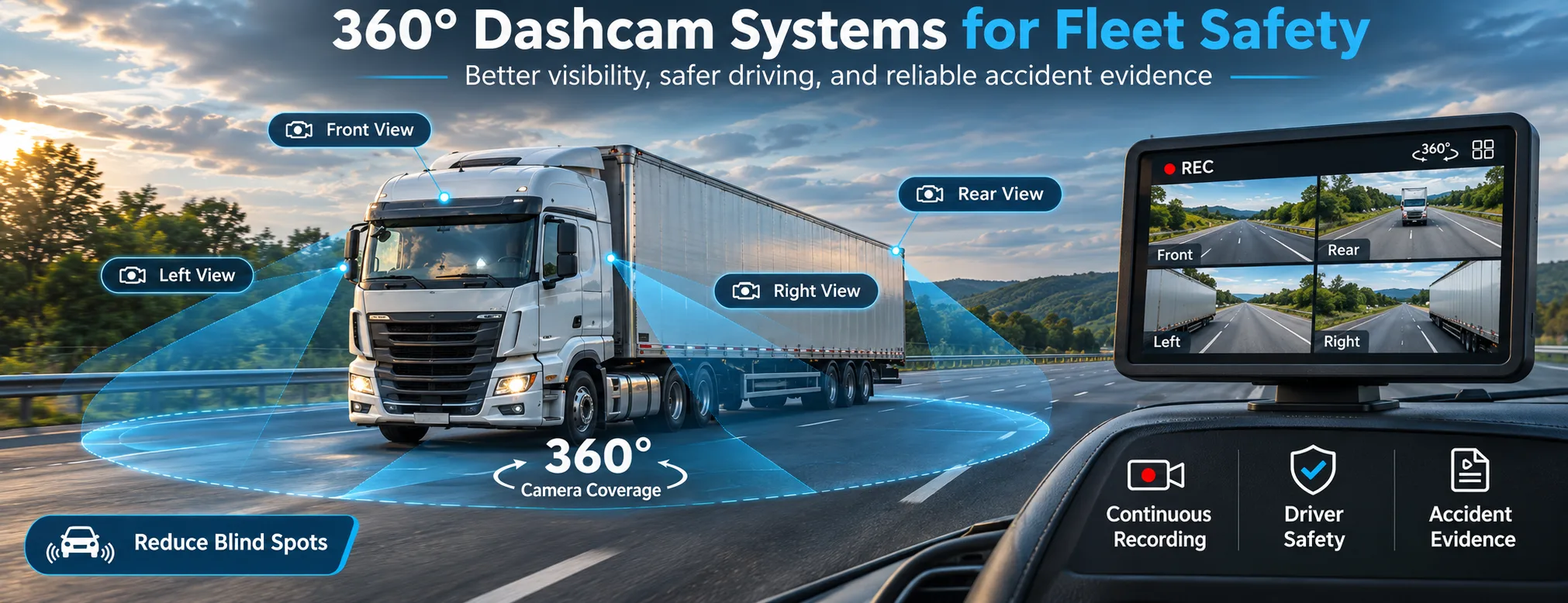
A 360-degree dashcam system is a vehicle camera setup designed to provide wider visibility around a truck, bus, or commercial vehicle.
Unlike a normal dashcam that records only the road ahead, a 360-degree system typically uses four cameras positioned around the vehicle.
These cameras capture different views and send the video to a monitor or recording device.
How Does a 360-Degree Camera System Work?
A typical system includes:
- Front camera: Records the road and traffic ahead.
- Rear camera: Shows vehicles, pedestrians, and obstacles behind.
- Left-side camera: Monitors activity along the left side.
- Right-side camera: Helps drivers observe traffic and objects on the right.
- Display monitor: Shows camera views inside the driver’s cabin.
- Mobile Digital Video Recorder (MDVR): Records and stores footage from connected cameras.
Some systems combine camera images into a bird’s-eye view, while others display four separate video feeds.
A true bird’s-eye view usually requires compatible cameras, special video processing, and proper calibration.
Not all surround-view systems include video recording, so businesses should confirm this feature before purchasing.
Why Blind Spots Are Dangerous for Commercial Vehicles
Large trucks and buses have areas around them that drivers cannot easily see through mirrors.
These areas are called blind spots.
Blind spots are especially dangerous when vehicles change lanes, turn at intersections, reverse, or move through crowded locations.
According to the Federal Motor Carrier Safety Administration (FMCSA), commercial vehicles have important visibility challenges, and drivers must carefully check their surroundings.
Common Situations Where Blind Spots Cause Problems
Turning at intersections: A motorcycle or bicycle may move close to a truck while the driver is turning.
Reversing: Workers or pedestrians may be standing behind a vehicle without being visible through mirrors.
Changing lanes: A car traveling beside a large truck may temporarily disappear from the driver’s view.
Industrial yards: Trucks frequently operate near loading equipment, parked vehicles, and moving workers.
A 360-degree camera system gives drivers additional views of these areas, helping them make more informed decisions.
However, cameras are safety aids, not replacements for mirrors, direct observation, or careful driving.
Five Ways 360-Degree Dashcams Improve Fleet Safety
1. Better Visibility Around Large Vehicles
The main advantage of a multi-camera system is improved surrounding visibility.
Side and rear cameras provide extra views that may not be available through traditional mirrors.
For example, a driver entering a narrow loading area can check camera views to better understand the position of nearby obstacles.
This is especially useful for long trucks, buses, and construction vehicles.
2. Safer Reversing and Parking
Reversing a commercial vehicle can be difficult because the driver may not have a clear view behind it.
Rear cameras help show objects, parked vehicles, and people near the reversing path.
With correct camera placement and a suitable monitor, drivers can check the area before continuing the maneuver.
A camera does not remove the need for a spotter when site rules or operating conditions require one.
3. Supporting Driver Safety
Drivers sometimes face unexpected situations caused by other road users.
For example, a motorcycle may suddenly move across a truck’s path, or a car may brake sharply ahead.
A dashcam can record the event and provide information during an investigation.
This helps protect drivers from unsupported claims when the footage clearly shows the sequence of events.
4. Improving Safety in Industrial Areas
Industrial locations often have limited space and frequent movement of trucks, forklifts, workers, and machinery.
Multi-camera systems help drivers monitor nearby activity during slow-speed operations.
They can be useful in warehouses, factories, ports, mining sites, and construction areas.
5. Helping Fleet Managers Review Incidents
Recorded videos allow fleet managers to understand how an incident happened.
Managers can review vehicle movements, road conditions, and driver decisions.
These recordings may also help identify situations where better training, safer procedures, or improved site arrangements are needed.
How Dashcam Footage Helps After a Road Accident
Road accidents often create confusion.
Drivers, passengers, and witnesses may describe the same incident differently.
Without video evidence, understanding what happened can be difficult.
A recording dashcam provides an additional source of information.
What Can Road Accident Video Evidence Show?
Depending on camera coverage and recording quality, footage may show:
- Vehicle movements before the accident
- Traffic signal conditions
- Sudden lane changes
- Dangerous overtaking
- Nearby pedestrians or motorcycles
- The direction of vehicle impact
- Events immediately before and after the collision
Video recordings may support police investigations, insurance reviews, and internal fleet investigations.
However, footage does not automatically prove legal responsibility. Its usefulness depends on recording quality, authenticity, completeness, and applicable laws.
Practical Example: A Truck and Motorcycle Collision
Imagine a truck making a turn at a busy intersection.
A motorcycle approaches near the truck’s side, and a collision occurs.
A front-facing dashcam may not capture the motorcycle’s movement clearly.
However, a properly positioned side camera may record the motorcycle’s position and movements before impact.
Investigators can review this footage alongside other evidence to understand the incident.
This example shows why multiple camera angles may be more useful than a single front-facing recording.
360-Degree Dashcam vs Traditional Dashcam
Both camera systems serve important purposes, but their coverage differs.
| Feature | Traditional Dashcam | 360-Degree System |
|---|---|---|
| Front road recording | Yes | Yes |
| Rear visibility | Optional | Usually included |
| Side visibility | Limited | Dedicated cameras |
| Blind-spot monitoring | Limited | Wider coverage |
| Multiple accident views | Limited | Available |
| Installation | Usually simpler | More complex |
For commercial fleets that need broader visibility, a multi-camera system may provide important advantages.
However, camera coverage depends on vehicle design, installation, and equipment quality.
Important Features to Consider Before Buying
Choosing a 360-degree dashcam system requires more than comparing prices.
Fleet operators should consider reliability, camera quality, recording capability, and installation requirements.
Video Quality and Night Visibility
Clear video is important when reviewing accidents.
Look for suitable recording resolution, good low-light performance, and stable video quality.
Rain, fog, darkness, and dirty camera lenses can still reduce visibility.
Recording and Storage
An MDVR may store video on an SD card or another supported storage device.
Some recorders automatically overwrite older footage when storage becomes full.
Businesses should understand the recording duration and backup process to avoid losing important evidence.
GPS Tracking Integration
Some commercial camera recorders can connect with GPS technology.
This may allow fleet managers to associate footage with vehicle location, route history, and timestamps.
Such features depend on the recorder and platform.
Durable Hardware
Commercial vehicles operate in challenging conditions.
Cameras and cables should be suitable for vibration, dust, rain, temperature changes, and regular vehicle movement.
Proper waterproofing, power connections, and secure mounting are essential.
How to Preserve Dashcam Footage After an Accident
A dashcam recording is useful only when the important footage remains available.
Fleet managers should have a clear process for protecting recordings after an accident.
Important Steps to Follow
Ensure everyone involved is safe and arrange emergency assistance where necessary.
Identify the correct vehicle, date, and incident time.
Save relevant footage before the recorder overwrites it.
Preserve original video files without editing them.
Keep recordings from all available camera angles.
Record who collected and accessed the footage.
Share evidence securely with authorized investigators or insurers.
The National Institute of Standards and Technology (NIST) emphasizes the importance of protecting digital evidence and documenting how it is handled.
Proper recordkeeping helps maintain confidence in the footage.
Common Problems With Vehicle Camera Systems
Even a good camera system can develop problems when installation or maintenance is poor.
Cameras Not Recording
Possible causes include damaged storage cards, power interruptions, faulty recorders, or incorrect recording settings.
Poor Image Quality
Dirty lenses, incorrect camera positioning, low lighting, or damaged cables may produce unclear video.
Missing Accident Footage
Important recordings may disappear when storage is overwritten or the recorder fails to save the event.
Incorrect Time and Date
Wrong timestamps can create confusion during accident investigations.
Fleet operators should regularly check recording status, camera views, storage health, and date settings.
Frequently Asked Questions
Conclusion
360-degree dashcam systems help improve fleet safety, driver visibility, and road accident documentation. With front, rear, and side cameras, commercial vehicle operators can monitor more of their surroundings and preserve useful footage when incidents occur.
Correct installation, reliable recording, and regular maintenance are essential for getting the most value from these systems.
Improve Fleet Visibility and Road Safety with Spectameta
Looking for better visibility around your commercial vehicles and more reliable accident recordings? Discover how 360-degree dashcam systems can help reduce blind-spot risks, improve driver awareness, capture critical road accident evidence, and enhance overall fleet safety. With the right camera technology, fleet operators can monitor vehicle surroundings, review incidents, protect drivers, and make safer, more informed decisions.
