


Benefits of Fleet Management Systems: 12 Ways to Improve Cost, Safety & Visibility
Managing a fleet is not only about knowing where vehicles are.
Fleet managers need to understand how vehicles are being used, where operating costs are increasing, whether drivers are following safe practices, when vehicles require maintenance and which fleet events need immediate attention.
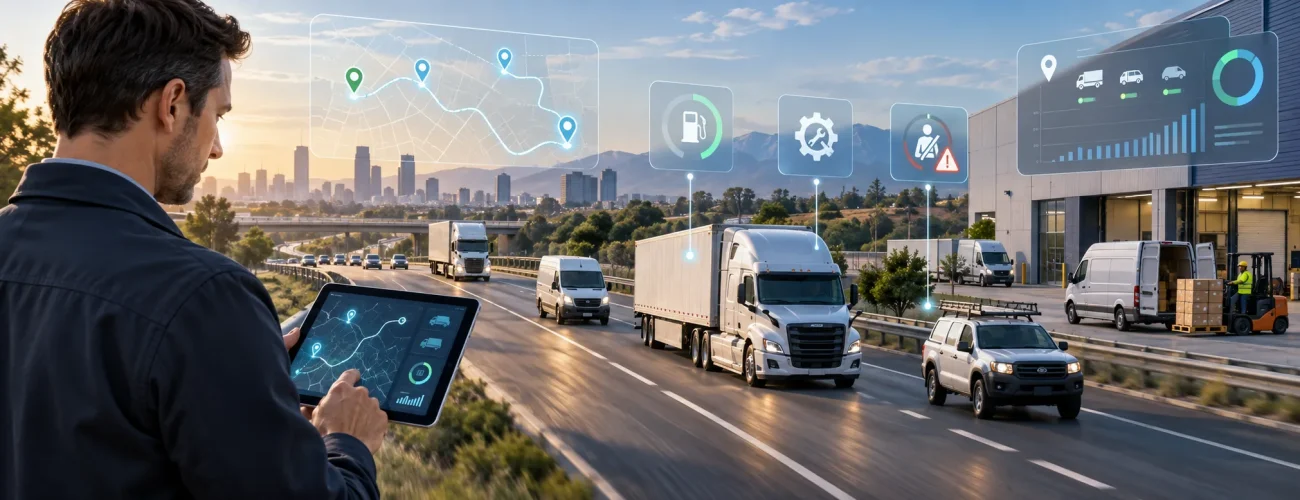
A connected fleet management system brings this information together.
By combining GPS tracking, telematics, fuel information, driver behaviour, vehicle activity and maintenance data, businesses can gain a clearer picture of day-to-day fleet operations.
The real value is not simply collecting more data.
It is using that information to reduce avoidable costs, improve fleet safety, increase vehicle utilization and make faster operational decisions.
This guide explains 12 practical benefits businesses can gain from a well-managed connected fleet.
What Is a Fleet Management System?
A fleet management system is a combination of software, vehicle connectivity and operational data used to monitor and manage commercial vehicles.
Depending on the technology and integrations available, a fleet platform may provide information about:
- Vehicle location
- Routes and trips
- Vehicle movement
- Idling
- Driver behaviour
- Fuel activity
- Vehicle utilization
- Maintenance requirements
- Fleet alerts
- Operational history
Instead of maintaining separate spreadsheets, phone updates and manual vehicle records, managers can use a centralized platform to monitor fleet activity.
For example, one vehicle may appear expensive to operate.
A connected system can help the fleet team investigate:
High operating cost
→ Fuel consumption
→ Idling
→ Route distance
→ Maintenance history
→ Vehicle utilization
→ Driver activity
This turns fleet data into a practical decision-making tool.
Why Is Fleet Management Important?
Commercial fleets operate with several costs and risks happening at the same time.
A vehicle can be:
- Travelling unnecessary kilometres
- Consuming more fuel than comparable vehicles
- Idling excessively
- Missing scheduled maintenance
- Operating below capacity
- Generating repeated driver-risk events
These problems may be difficult to identify when information is fragmented.
Fleet management creates visibility across those activities.
This helps managers answer questions such as:
- Which vehicles are currently active?
- Where are delays occurring?
- Which vehicles have high fuel consumption?
- Are drivers repeatedly speeding or braking harshly?
- Which assets are underutilized?
- Which vehicles are due for maintenance?
- Is fleet cost per kilometre increasing?
That is why fleet management is increasingly about operational intelligence, not just vehicle tracking.
12 Key Benefits of Fleet Management Systems
A modern fleet platform can support different areas of an operation.
The most valuable benefits usually come from connecting vehicle information with a clear operational process.
1. Better Fleet Visibility
Knowing where vehicles are is one of the most basic requirements of fleet management.
GPS tracking can help managers monitor:
- Current vehicle location
- Vehicle movement
- Route history
- Trip progress
- Stoppages
- Arrival and departure activity
This reduces dependence on repeated phone calls and manual status updates.
Better visibility also allows dispatch teams to understand which vehicles are:
- Moving
- Stopped
- Idle
- Available
- Delayed
That creates a stronger operational picture across the fleet.
The key benefit is not simply seeing vehicles on a map.
It is understanding which vehicles require attention and which are operating normally.
2. Lower Fleet Operating Costs
Fleet operating costs are influenced by several variables, including:
- Fuel
- Maintenance
- Tyres
- Driver time
- Toll expenses
- Vehicle utilization
- Empty running
- Downtime
Connected fleet data can help managers identify areas where costs are increasing.
For example:
Cost per kilometre rises
→ Check fuel cost
→ Review maintenance cost
→ Compare vehicle utilization
→ Examine route distance
→ Identify the main cost driver
This is more useful than simply knowing that the monthly fleet bill increased.
Fleet management helps turn cost information into something that can be investigated.
3. Improved Fuel Control
Fuel can represent a significant operating expense for commercial fleets.
Fleet managers therefore need more than a monthly fuel total.
Useful fuel information may include:
- Vehicle fuel consumption
- Fuel efficiency
- Refuelling activity
- Significant fuel-level changes
- Fuel cost per kilometre
- Idling patterns
When compatible fuel-monitoring hardware is available, fleet teams can also investigate unusual fuel events.
The objective should not be to assume every abnormal event is fuel theft.
A better approach is:
Unusual fuel activity
→ Check vehicle
→ Check location
→ Review trip activity
→ Compare fuel history
→ Investigate where necessary
This helps fleets manage fuel based on data rather than assumptions.
4. Reduced Excessive Idling
A stationary vehicle can still consume fuel.
If the engine remains running unnecessarily, the fleet may spend money without gaining productive distance.
Fleet managers can monitor:
- Total idle time
- Frequent idle locations
- High-idling vehicles
- Repeated driver patterns
Some idling may be operationally necessary.
For example:
- Loading
- Temperature control
- Traffic
- Site operations
The goal is therefore not to eliminate every minute of idling.
It is to identify avoidable idling that creates unnecessary fuel use and engine hours.
5. Safer Driver Behaviour
Driver behaviour directly influences fleet safety.
Depending on available telematics data, fleet managers may be able to review events such as:
- Speeding
- Harsh acceleration
- Harsh braking
- Excessive idling
- Repeated driving exceptions
The value comes from looking for patterns.
One harsh-braking event may be caused by another vehicle suddenly entering the road.
Repeated events from the same driver may require further review.
A useful process is:
Driver event detected
→ Review frequency
→ Check route context
→ Compare previous activity
→ Coach the driver if necessary
→ Monitor improvement
This makes driver monitoring part of a safety-improvement process rather than only a disciplinary tool.
6. Better Route and Trip Control
Fleet managers often need to know more than the vehicle’s final destination.
They need visibility throughout the trip.
Useful trip information can include:
- Planned route
- Actual route
- Trip distance
- Stoppages
- Delays
- Route deviations
- Arrival time
- Departure time
When a route deviation occurs, managers can determine whether it was caused by:
- Traffic
- Road closure
- Customer instructions
- Driver choice
- Operational requirements
Trip monitoring can help dispatch teams respond more quickly when a journey is not progressing as expected.
7. Improved Vehicle Utilization
Owning more vehicles does not automatically mean a fleet is more productive.
Some assets may be underused while others are operating continuously.
Vehicle utilization helps fleet managers understand how effectively fleet capacity is being used.
A simple utilization calculation is:
Vehicle Utilization Rate = Productive Vehicle Time ÷ Available Vehicle Time × 100
Low utilization may indicate:
- Excess fleet capacity
- Poor vehicle allocation
- Uneven workload
- Vehicle downtime
- Weak dispatch planning
Very high utilization can also create problems if maintenance windows are continuously postponed.
The objective is balanced use of fleet assets.
8. Better Preventive Maintenance Planning
Unexpected breakdowns can disrupt fleet operations.
Preventive maintenance helps managers schedule inspections and service before predictable issues become failures.
Maintenance planning may use:
- Kilometres travelled
- Engine hours
- Time intervals
- Vehicle history
- Manufacturer recommendations
Typical maintenance activities may include:
- Oil and filter changes
- Brake inspection
- Tyre checks
- Fluid inspection
- Electrical checks
- Engine servicing
Connected fleet information can help managers understand when vehicles are approaching service thresholds.
This is more reliable than depending only on manual reminders.
9. Reduced Vehicle Downtime
A vehicle that is unavailable cannot perform productive work.
Unplanned downtime can lead to:
- Delayed deliveries
- Lower fleet capacity
- Replacement-vehicle requirements
- Higher repair expenses
- Customer disruption
Fleet managers should therefore track downtime separately.
Useful questions include:
- Which vehicles experience the most downtime?
- Are failures recurring?
- Are maintenance schedules being followed?
- How long does each repair take?
- Are older vehicles becoming increasingly expensive to keep operational?
Tracking these patterns can improve maintenance and replacement decisions.
10. Faster Response to Fleet Events
Fleet operations generate many events.
The challenge is identifying which ones actually require action.
Examples may include:
- Vehicle leaving a planned route
- Long unexpected stoppage
- Significant fuel drop
- Driver safety event
- Maintenance threshold
- Geofence entry or exit
A useful alert should support an operational workflow.
For example:
Unexpected route deviation
→ Check current location
→ Review trip route
→ Contact driver if necessary
→ Record reason
This is much more useful than generating large numbers of alerts that nobody reviews.
A good fleet system helps teams focus on exceptions rather than normal activity.
11. Better Customer Service and Trip Accountability
Fleet visibility can also improve communication with customers.
When businesses have better information about vehicle and trip status, they can respond more confidently to questions such as:
- Has the vehicle left the depot?
- Is the trip delayed?
- Has the vehicle reached the customer location?
- When did the vehicle arrive?
- How long did it remain at the site?
This does not mean every internal fleet detail needs to be shared externally.
It means operations teams have better information available when customers need an update.
Trip history can also provide useful records when delivery timing or route activity needs to be reviewed later.
12. Smarter Fleet Decisions Using Operational Data
One of the biggest benefits of connected fleet technology is the ability to move from assumptions to measurable information.
Instead of saying:
“This truck seems expensive.”
Managers can review:
- Fuel cost per kilometre
- Maintenance cost
- Downtime
- Utilization
- Idling
- Route distance
Instead of saying:
“This driver may be risky.”
Managers can review:
- Speeding events
- Harsh braking
- Harsh acceleration
- Event frequency
- Route conditions
This improves the quality of operational decisions.
The goal is not to collect every possible metric.
It is to use the right data to answer specific fleet-management questions.
Benefits of Fleet Management at a Glance
| Area | Operational Benefit |
|---|---|
| Vehicle Tracking | Better location and trip visibility |
| Fleet Cost | Easier identification of cost drivers |
| Fuel | Better consumption and fuel-event monitoring |
| Idling | Identification of avoidable engine activity |
| Driver Safety | Better visibility into recurring risk events |
| Routing | Improved trip and route control |
| Utilization | Better use of fleet assets |
| Maintenance | More structured service planning |
| Downtime | Better vehicle availability |
| Alerts | Faster response to important exceptions |
| Customer Service | Better trip-status information |
| Analytics | More informed operational decisions |
How GPS Tracking and Telematics Work Together
GPS tracking and telematics are related but not identical.
GPS primarily helps answer:
Where is the vehicle?
Telematics can add broader operational information such as:
- Vehicle movement
- Driver activity
- Idling
- Trips
- Vehicle data
- Fleet events
When connected with other systems, fleet managers can build a more complete picture.
For example:
GPS location
- Trip history
- Driver behaviour
- Fuel information
- Vehicle data=More complete fleet visibility
The value comes from connecting these data sources rather than managing each one separately.
How Fuel Monitoring Supports Fleet Management
Fuel data can support several operational decisions.
Fleet managers can compare:
- Fuel consumption
- Distance travelled
- Fuel cost
- Idling
- Similar vehicles
A simple fuel-efficiency calculation is:
Fuel Efficiency = Distance Travelled ÷ Fuel Consumed
For example:
Distance = 1,500 km
Fuel consumed = 250 litres
Fuel efficiency:
1,500 ÷ 250 = 6 km/L
The result should be compared with:
- The same vehicle over time
- Similar vehicles
- Similar routes
- Similar loads
Avoid using one universal efficiency target for every vehicle.
Different vehicle types and duty cycles can produce very different results.
Why Fleet Visibility Matters
Vehicle tracking becomes more useful when managers can understand fleet activity beyond a map.
Good operational visibility helps answer:
- Which vehicles are moving?
- Which vehicles have stopped?
- Which trips are delayed?
- Which vehicles are idle?
- Which vehicles have generated important events?
This allows fleet managers to prioritize attention.
Instead of checking every vehicle manually, teams can focus on exceptions.
That is one reason fleet visibility is an important part of modern fleet operations.
Which Businesses Can Benefit from Fleet Management?
Connected fleet management can support businesses operating commercial vehicles across many industries.
Logistics and Transportation
Useful for:
- Vehicle tracking
- Trip monitoring
- Route visibility
- Driver safety
- Fleet utilization
Construction and Infrastructure
Useful for:
- Heavy-equipment visibility
- Fuel monitoring
- Engine-hour tracking
- Site activity
- Asset utilization
Manufacturing and Distribution
Useful for:
- Dispatch visibility
- Delivery tracking
- Route monitoring
- Vehicle allocation
Oil and Gas
Useful for:
- Tanker tracking
- Fuel oversight
- Route monitoring
- Driver safety
- Remote fleet visibility
Rental and Leasing
Useful for:
- Asset tracking
- Utilization
- Vehicle movement
- Unauthorized-use monitoring
The exact configuration should depend on the operating problem the business is trying to solve.
How to Measure Whether Fleet Management Is Working
Installing fleet technology does not automatically guarantee improvement.
Businesses should measure results.
Useful KPIs include:
| KPI | What It Measures |
|---|---|
| Fuel Efficiency | Vehicle fuel performance |
| Fuel Cost per KM | Fuel operating cost |
| Fleet Cost per KM | Overall cost efficiency |
| Idle Time | Non-productive engine activity |
| Vehicle Utilization | Productive use of fleet assets |
| Empty Kilometres | Unproductive vehicle movement |
| Vehicle Uptime | Fleet availability |
| Unplanned Downtime | Unexpected vehicle loss |
| Maintenance Compliance | Scheduled service completion |
| Driver Risk Event Rate | Frequency of driving-risk events |
| On-Time Trips | Trip reliability |
The best comparison is often:
same vehicle vs previous period
or:
similar vehicles performing similar work
This gives fleet managers an internal baseline they can actually act on.
Common Mistakes When Using Fleet Management Technology
A system can provide useful data and still fail to improve operations if it is poorly managed.
Tracking Too Many Metrics
More data does not automatically mean better decisions.
Start with metrics connected to specific business problems.
Creating Too Many Alerts
If every event becomes an alert, important exceptions can be missed.
Prioritize alerts that require action.
Comparing Different Vehicles Without Context
A heavy truck, delivery van and construction vehicle should not be judged using identical operating benchmarks.
Ignoring Driver Context
One event does not always indicate poor driving.
Review frequency, road conditions and route characteristics.
Collecting Data Without Acting on It
Fleet information is valuable only when someone reviews it and takes appropriate action.
The most effective process is:
Data → Exception → Investigation → Action → Measurement
How Spectameta Supports Connected Fleet Operations
Spectameta helps businesses improve fleet visibility by connecting vehicle and operational information across a centralized fleet environment.
Depending on vehicle requirements and available integrations, connected fleet technologies can support areas such as:
- GPS vehicle tracking
- Fleet monitoring
- Fuel monitoring
- Driver behaviour insights
- Telematics
- Vehicle activity
- Trip monitoring
- Fleet alerts
- Operational reporting
The objective is not to overwhelm teams with dashboards.
The objective is to help fleet managers understand:
what is happening
where it is happening
why it may be happening
and
what action may be required
For example:
Fuel cost increases
→ Review fuel efficiency
→ Check idling
→ Compare similar vehicles
→ Review route activity
→ Investigate the cause
Or:
Trip performance declines
→ Check route deviations
→ Review stoppages
→ Compare trip duration
→ Identify recurring delays
This is how fleet technology becomes useful to day-to-day operations.
Frequently Asked Questions
Conclusion
The benefits of connected fleet management go far beyond vehicle location.
A well-structured system can help businesses improve:
- Visibility
- Cost control
- Fuel management
- Driver safety
- Vehicle utilization
- Maintenance
- Operational decision-making
The most important step is not collecting more information.It is identifying the operational questions that matter and connecting the right data to those decisions.
A fleet manager who can see vehicle activity, fuel performance, driver behaviour, trip progress and maintenance requirements has a much stronger foundation for managing fleet performance.That is where fleet technology creates real value.
Build a Smarter, More Visible Fleet with Spectameta
Spectameta helps businesses connect vehicle tracking, fleet monitoring, fuel information, telematics and operational insights into a more centralized fleet environment.
Whether the goal is to improve visibility, understand fuel consumption, monitor vehicle activity or make better fleet decisions, connected data gives fleet managers a clearer view of daily operations.
