



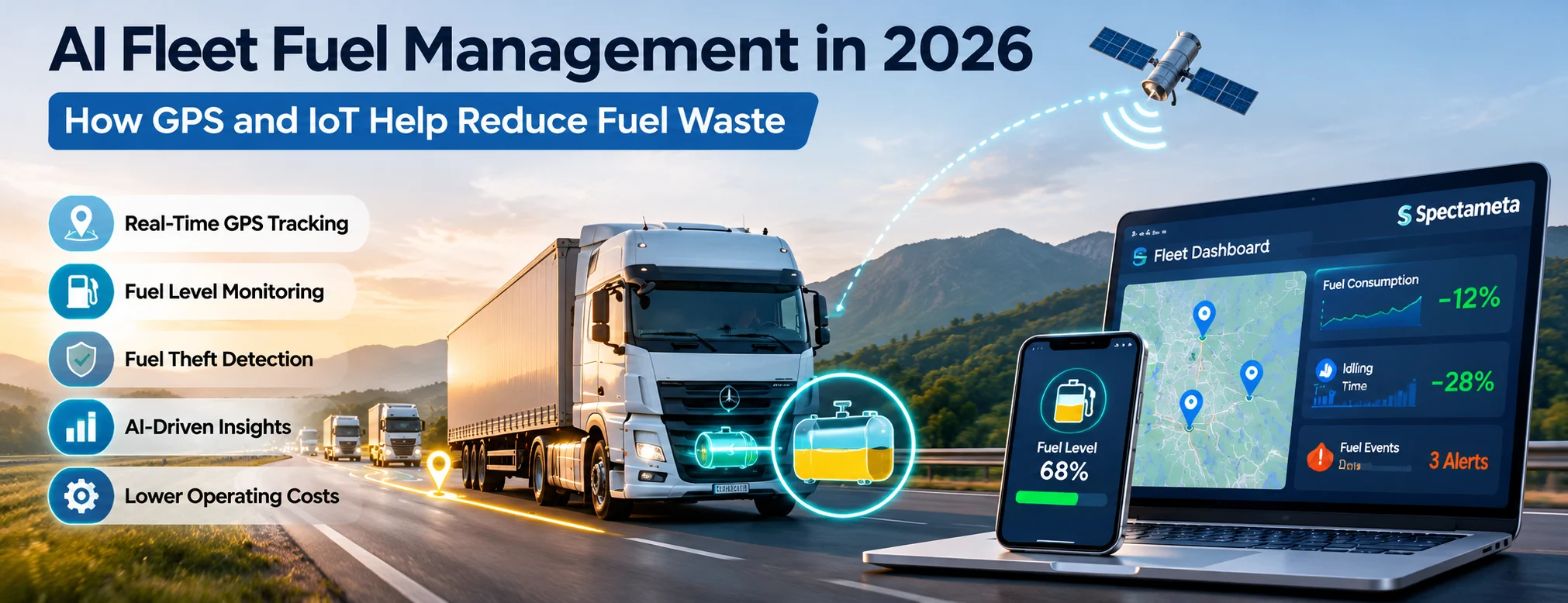
AI Fleet Fuel Management in 2026: How GPS and IoT Help Reduce Fuel Waste
Fuel is one of the biggest operating expenses for transport companies, logistics providers, and industrial fleets. Yet many businesses still struggle to understand where their fuel goes.
A truck may consume more diesel than expected. A vehicle may spend hours idling. A fuel tank may show a sudden drop in level. Without reliable data, finding the reason can be difficult.
This is why AI-powered fleet fuel management systems are receiving more attention in 2026.
By combining GPS tracking, IoT fuel sensors, vehicle data, and intelligent analytics, fleet operators can better understand fuel consumption, identify unusual activity, and improve daily operations.
But how does this technology actually work? And can it really help businesses reduce fuel waste?
Let’s explore.
Why Fleet Fuel Management Matters More in 2026
Fuel cost management remains a major challenge for commercial fleets.
According to Geotab-sponsored research published on October 28, 2026, 82% of surveyed trucking organizations reported increasing operating costs over the previous 12 months. Fuel costs were the most frequently mentioned cause, appearing in 31% of responses.
These findings reflect growing pressure on fleet operators to measure and control expenses.
Common Reasons for Higher Fleet Fuel Costs
Fuel expenses can increase because of:
- Excessive engine idling
- Poor route planning and traffic delays
- Aggressive acceleration and driving habits
- Engine or vehicle maintenance problems
- Unauthorized fuel removal
- Inaccurate fuel records
- Poor vehicle utilization
Not every fuel loss is caused by theft. Many are related to everyday operating conditions.
The challenge is identifying the actual cause rather than simply noticing that fuel expenses have increased.
What Is an AI Fleet Fuel Management System?
An AI fleet fuel management system uses vehicle and fuel-related data to help operators monitor consumption, recognize patterns, and investigate unusual events.
A typical system may combine GPS trackers, fuel level sensors, vehicle diagnostics, cloud software, and analytics.
Traditional systems mainly display measurements and generate alerts. AI-enabled systems can go further by comparing historical behavior, identifying anomalies, and highlighting vehicles that need attention.
How GPS Tracking Helps Monitor Fleet Activity
A GPS tracking device collects location, speed, movement, and other information depending on its hardware capabilities and installation.
Fleet management software can use this information to analyze:
- Vehicle routes and distance traveled
- Engine idling and operating hours, where available
- Unplanned stops
- Vehicle utilization
- Repeated inefficient journeys
GPS tracking alone does not directly measure the amount of diesel inside a fuel tank.
For reliable physical fuel-level monitoring, the system generally needs a compatible fuel sensor or suitable vehicle fuel data.
How IoT Fuel Sensors Measure Fuel Levels
IoT fuel monitoring systems use sensors to measure fuel-related conditions and transmit readings to a monitoring platform.
Common technologies include:
Capacitive fuel level sensors: These detect changes in electrical capacitance associated with the fuel level. Proper installation and calibration are essential.
Ultrasonic fuel level sensors: These use ultrasonic signals to estimate fuel level. Measurement quality depends on sensor design, mounting, tank conditions, and signal reliability.
Vehicle fuel data: Some vehicles provide fuel-level or fuel-consumption information through supported onboard electronic interfaces.
Each method has advantages and limitations. The best choice depends on the vehicle, tank construction, accuracy requirements, and installation environment.
How GPS, IoT, and AI Work Together
An integrated fuel management system connects multiple types of operational information.
The basic process is:
A fuel sensor or supported vehicle interface provides fuel measurements.
A GPS tracker records vehicle location and movement.
A telematics device sends available data through a communication network.
A cloud platform stores and processes the measurements.
Analytics software evaluates fuel changes and vehicle activity.
Fleet managers review alerts and reports before taking action.
Example: Detecting an Unusual Fuel Drop
Imagine a commercial truck parked overnight.
The monitoring system records a fuel level of approximately 180 litres. Later, the sensor reports 145 litres.
The apparent difference is 35 litres.
A fuel monitoring platform could flag this event for investigation, particularly if it occurred while the vehicle was stationary.
However, a sudden level change is not automatic proof of fuel theft.
Other possible explanations include:
- Fuel movement inside the tank
- A vehicle parked on uneven ground
- Sensor errors or faulty wiring
- Incorrect tank calibration
- Data transmission or synchronization problems
A properly designed system should use filtering, event conditions, and other available vehicle information to reduce false alarms.
The fleet operator can then investigate the event using supporting evidence.
Five Ways Smart Fuel Monitoring Can Help Reduce Fuel Waste
1. Identifying Excessive Engine Idling
When a vehicle’s engine continues running while stationary, it may consume fuel without covering any distance.
GPS and engine-status information can help fleet operators identify unnecessary idling.
Managers can compare idle time across vehicles, routes, and drivers while accounting for legitimate operating needs, such as refrigeration or power take-off equipment.
2. Improving Route Planning
Longer routes, congestion, repeated detours, and unnecessary journeys can increase fuel use.
GPS tracking data helps operators understand actual travel patterns.
Route analysis can support better dispatch decisions and reduce avoidable mileage.
3. Investigating Possible Fuel Theft
Fuel monitoring systems can identify sudden or unusual changes in reported tank levels.
When combined with GPS information, refueling records, and operational context, these alerts can help identify events that deserve investigation.
They should be treated as evidence for review, not a final determination of wrongdoing.
4. Finding Vehicles With Abnormal Consumption
Two similar trucks may use different amounts of fuel because of their load, route, road conditions, driver behavior, or mechanical condition.
Monitoring trends over time can help managers find vehicles that consistently operate outside an expected range.
Maintenance teams can then investigate possible problems such as incorrect tyre pressure, poor engine performance, or fuel-system faults.
5. Improving Fuel Reporting
Manual fuel records can be incomplete or difficult to reconcile.
An integrated system can bring together fuel measurements, vehicle activity, and transaction records to make reporting more consistent.
This helps managers compare expected consumption, recorded refueling, and available tank-level information.
AI Fuel Monitoring vs Traditional Fuel Monitoring
| Feature | Traditional fuel monitoring | AI-assisted fuel monitoring |
|---|---|---|
| Fuel level display | Yes, with suitable data | Yes, with suitable data |
| Basic threshold alerts | Yes | Yes |
| Historical consumption trends | Often available | Often available |
| Unusual-pattern detection | Fixed rules or manual review | Can use statistical or machine-learning models |
| Predictive insights | Limited or platform-dependent | Possible with adequate data |
| Automatic recommendations | Platform-dependent | Possible on supported systems |
AI does not make inaccurate sensors accurate. Reliable measurements, calibration, and data quality remain essential.
Challenges When Installing an IoT Fuel Monitoring System
Even advanced software cannot compensate for poor hardware installation or unreliable measurements.
Incorrect Fuel Sensor Calibration
Fuel tanks are not always rectangular or uniformly shaped.
As a result, a small change in fuel height does not necessarily represent the same volume change throughout the tank.
Accurate litre-based reporting may require a tank-specific calibration table.
GPS and Network Connectivity Problems
Buildings, tunnels, underground parking, and remote industrial areas can affect satellite reception or mobile network connectivity.
A suitable telematics device may store measurements locally and transmit them after communication is restored, depending on its design and configuration.
Fuel Movement and Vehicle Tilt
Fuel can move inside a tank during braking, acceleration, turning, or travel over uneven ground.
Sensor filtering and suitable alert conditions are important to distinguish normal fluctuations from meaningful events.
Hardware Compatibility
Before installation, operators should verify the sensor interface, device voltage, communication protocol, vehicle compatibility, and software support.
For industrial applications, environmental protection, vibration resistance, cable routing, and electrical safety also matter.
How to Choose the Right Fleet Fuel Management Solution
A good system should match the actual operating conditions of the fleet.
Before choosing a solution, ask:
- Does it support our vehicle types and fuel tanks?
- Which fuel measurement method does it use?
- What calibration process is required?
- Can it integrate GPS and fuel data?
- How does it handle poor network coverage?
- Can users review the evidence behind alerts?
- What technical support and maintenance are available?
For fleets operating trucks, buses, construction equipment, or industrial machinery, the most expensive option is not automatically the most suitable.
A successful deployment depends on reliable measurements, practical installation, useful reporting, and consistent follow-up.
What Is the Future of Fleet Fuel Management?
Fleet fuel management is moving beyond simple location tracking and basic consumption reports.
According to Geotab’s 2026 telematics trends analysis, connected fleet technology is increasingly focused on predictive insights, integrated data, and more proactive operational decisions.
Likely areas of continued development include:
- AI-assisted anomaly detection
- Automated fuel reconciliation
- Integration of vehicle diagnostics with fuel data
- Predictive maintenance insights
- More unified fleet dashboards
- Improved analysis of operating costs
Still, AI should support informed human decisions rather than replace verification and technical judgment.
Final Thoughts
In 2026, effective fleet fuel management is about more than knowing how much diesel was purchased.
Fleet operators need to understand where fuel is used, which operating conditions increase consumption, and why unusual events occur.
GPS tracking, IoT fuel sensors, and intelligent analytics can provide valuable visibility when the system is correctly selected, installed, calibrated, and maintained.
For transport companies and industrial fleet operators, the best starting point is to identify a specific fuel-management problem, measure current performance, and select technology that addresses that problem reliably.
To explore telematics and industrial IoT technology further, visit Spectameta.
Frequently Asked Questions
Can GPS tracking detect fuel theft?
GPS tracking alone cannot measure fuel theft. When combined with suitable fuel sensors, vehicle data, and monitoring software, it can help identify unusual fuel-level changes for investigation.
Can AI reduce fleet fuel consumption?
AI-assisted analysis can help identify inefficient routes, excessive idling, abnormal consumption, and other opportunities for improvement. Actual savings depend on fleet conditions and the actions taken.
Which fuel sensor is best for commercial trucks?
There is no single best sensor for every truck. Selection depends on tank geometry, operating environment, installation requirements, available vehicle data, and the level of measurement accuracy needed.
Can fuel monitoring work without internet connectivity?
Some IoT devices support local data storage during network interruptions and transmit records after connectivity returns. This depends on the specific device and its configuration.
Is AI fuel monitoring suitable for small fleets?
It can be, but smaller fleets should evaluate installation costs, subscription fees, measurable benefits, and the complexity of the system before investing.
Frequently Asked Questions
Conclusion
AI-powered fleet fuel management is transforming how businesses monitor and control fuel consumption in 2026. By combining GPS tracking, IoT fuel sensors, and AI-driven analytics, fleet operators can identify fuel waste, detect unusual fuel losses, reduce unnecessary idling, and improve operational efficiency.
However, accurate results depend on proper sensor installation, calibration, and reliable data. With the right technology and informed decisions, businesses can achieve better fuel visibility and cost control.
Explore more insights on GPS tracking, fuel monitoring, and industrial IoT solutions at Spectameta.
Take Control of Your Fleet Fuel Costs with Spectameta
Struggling with high fuel consumption, unexpected fuel losses, or limited fleet visibility? Discover how GPS tracking, IoT fuel monitoring, and smart fleet management technologies can help you monitor fuel usage, identify inefficiencies, and make better operational decisions.
Explore smarter fleet management with Spectameta.
