



Vehicle Telematics Solutions: How GPS Tracking, Fuel Monitoring and IoT Improve Fleet Operations
Managing a commercial fleet involves much more than knowing where vehicles are located. Fleet operators need accurate information about fuel consumption, driving behavior, vehicle performance, route efficiency and operational problems.
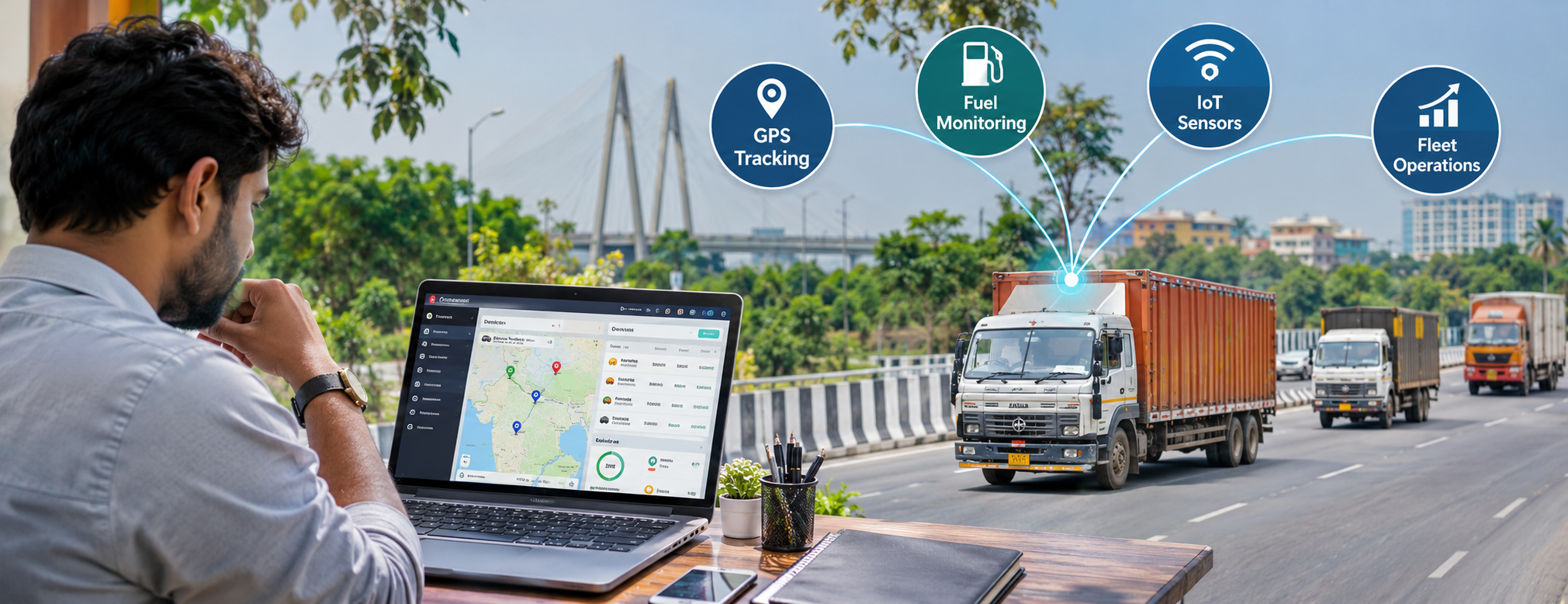
Vehicle telematics solutions combine GPS tracking, wireless communication, sensors and software to collect vehicle data and turn it into useful information for fleet management. When properly implemented, these systems can help transport companies improve visibility, investigate fuel losses, identify inefficient vehicle use and make better operational decisions.
Whether you manage delivery vans, heavy trucks, buses, construction equipment or logistics vehicles, understanding how telematics works is the first step toward choosing the right technology.
What Is a Vehicle Telematics System?
A vehicle telematics system is a technology solution that collects, transmits and analyzes information from vehicles using GPS, communication networks, vehicle interfaces and connected sensors.
It allows fleet operators to remotely monitor information such as:
- Real-time vehicle location and trip history
- Vehicle speed, movement and idle time
- Fuel level and fuel consumption patterns
- Driving behavior and unusual vehicle activity
- Engine diagnostics, when compatible interfaces are available
- Vehicle maintenance requirements
- Geofence entry and exit events
A typical system consists of an onboard telematics device, an appropriate communication connection, a cloud or server-based processing platform and a user dashboard.
The important distinction: GPS provides location information, while telematics combines location with other operational data to help businesses understand how their vehicles are being used.
How Do Vehicle Telematics Solutions Work?
A vehicle telematics system follows a relatively straightforward process.
Step 1: Collect vehicle information
A GPS tracking device determines a vehicle’s location using satellite navigation signals.
Depending on the device and installation, the system may also collect data from external sensors, digital inputs, vehicle diagnostics or CAN bus interfaces.
Step 2: Transmit the data
The telematics device sends collected information to a remote server, commonly through a cellular data network.
Some devices can temporarily store records when network coverage is unavailable and upload them after connectivity returns.
Step 3: Process the information
Software processes incoming records and converts them into meaningful information, such as trip summaries, route histories, idle duration and event notifications.
Step 4: Display information to fleet managers
Fleet operators access the processed information through a web dashboard or mobile application.
Step 5: Generate alerts and reports
The platform can generate notifications when configured conditions are detected, including unauthorized movement, overspeeding, geofence violations or unusual fuel-level changes.
The usefulness of these features depends on device compatibility, installation quality, sensor accuracy, network availability and software configuration.
What Is the Difference Between GPS Tracking and Vehicle Telematics?
GPS tracking and vehicle telematics are closely related, but they do not provide exactly the same information.
| Feature | GPS tracking | Vehicle telematics |
|---|---|---|
| Vehicle location | Yes | Yes |
| Route history | Typically available | Typically available |
| Speed monitoring | Commonly available | Commonly available |
| Fuel-level monitoring | Requires compatible sensor integration | Available with compatible hardware and software |
| Engine diagnostics | Not inherent to basic GPS | Possible with supported vehicle interfaces |
| Driver behavior analysis | Basic movement-based events | Can combine movement and vehicle data |
| Maintenance insights | Limited | Possible when relevant data is available |
| Operational reporting | Basic tracking reports | Broader fleet and vehicle reports |
Which should a business choose?
A basic GPS tracker may be sufficient for businesses that mainly want location visibility and movement alerts.
A more comprehensive telematics solution is generally better suited to operators who also need fuel monitoring, vehicle diagnostics, driver behavior analysis or integration with fleet management workflows.
How Does GPS Fleet Tracking Help Transport Companies?
GPS fleet tracking helps operators understand where vehicles are, where they have traveled and whether operations are following planned schedules.
Real-time vehicle visibility
Fleet managers can monitor vehicle positions without repeatedly contacting drivers for location updates.
This is useful for dispatch coordination, delivery planning and responding to customer enquiries.
Route history and trip analysis
Historical trip records help identify route deviations, unnecessary travel and operational delays.
However, GPS data alone does not explain every delay. Traffic conditions, loading procedures, customer waiting time and permitted driver breaks may also influence vehicle movement.
Geofencing and movement notifications
A geofence is a virtual boundary defined around a physical location.
For example, a logistics company can configure notifications when a truck enters or leaves a warehouse, depot or customer facility.
Idle-time monitoring
Extended idling can increase fuel use and operating costs.
Vehicle tracking can help identify prolonged stationary periods, although determining whether the engine was running may require ignition signals or additional vehicle data.
What Is a Fuel Level Sensor, and How Does It Work?
A fuel level sensor measures the amount or level of fuel inside a vehicle’s tank.
When integrated with a compatible GPS or telematics system, the sensor can provide fuel-level records and help operators investigate refueling activity, consumption trends and unexpected fuel losses.
Fuel sensors use different measurement technologies.
1. Capacitive fuel level sensors
Capacitive sensors measure changes in electrical capacitance associated with the fuel level surrounding a probe.
These sensors are commonly used in commercial vehicle fuel monitoring applications.
Installation and calibration are important because tank geometry, fuel properties and operating conditions affect measurements.
2. Ultrasonic fuel level sensors
Ultrasonic sensors use sound waves to estimate the distance to the fuel surface.
Some designs can measure through the tank wall without penetrating the tank, provided that the material and installation conditions are suitable.
Measurement quality may be affected by tank construction, mounting position, vibration and internal obstructions.
3. Original equipment fuel sensors
Some telematics systems can read fuel-related information from a vehicle’s existing electronics through a compatible diagnostic or CAN interface.
However, the availability, resolution and accuracy of this information vary by vehicle.
Capacitive vs Ultrasonic Fuel Sensors: Which Is Better?
The right fuel sensor depends on tank construction, installation requirements, fuel type and the accuracy needed for the application.
| Comparison | Capacitive sensor | Ultrasonic sensor |
|---|---|---|
| Measurement method | Electrical capacitance | Ultrasonic sound waves |
| Installation | Often requires an in-tank probe | Some models support external mounting |
| Tank compatibility | Depends on probe and tank configuration | Depends on material and acoustic conditions |
| Calibration | Usually important | May require tank-specific configuration |
| Common challenges | Fuel properties, probe installation | Tank geometry, vibration, signal reflections |
| Typical application | Commercial vehicle fuel monitoring | Suitable tanks requiring non-invasive measurement |
Neither sensor technology is universally superior.
Before selecting a sensor, operators should confirm whether it supports their vehicle’s tank type, fuel type, working environment and telematics device.
Can GPS Tracking Detect Fuel Theft?
GPS tracking alone cannot reliably measure fuel theft. Detecting suspicious fuel-level changes generally requires a compatible fuel sensor or suitable vehicle fuel data.
A fuel monitoring system can help identify events such as an unexpected reduction in measured fuel level while a vehicle is stationary.
For example, consider a vehicle parked overnight at a depot. If the fuel monitoring system records a sudden decrease in tank level, it can generate an alert for the fleet manager.
However, an alert does not automatically prove theft.
Fuel movement inside the tank, parking angle, sensor calibration, temperature, measurement noise and legitimate maintenance activities can sometimes produce misleading readings.
A responsible investigation should compare the fuel record against vehicle position, ignition status, operating conditions and other available evidence.
How Does IoT Improve Vehicle Telematics?
The Internet of Things, or IoT, allows physical devices and sensors to exchange information with connected applications.
In fleet operations, IoT expands the information that telematics systems can collect.
For example, a refrigerated transport vehicle may use:
- GPS tracking to record the vehicle’s location
- Temperature sensors to monitor cargo conditions
- Door sensors to detect opening and closing events
- Fuel sensors to monitor tank levels
- Telematics communication devices to transmit information
- Fleet software to display readings and generate alerts
Instead of monitoring these activities independently, a suitably designed IoT fleet solution can bring them into a common operational workflow.
This can be particularly useful in cold-chain transportation, commercial logistics, construction equipment monitoring and other sensor-intensive applications.
How Can Fleet Managers Choose the Right Telematics Solution?
Selecting a fleet telematics solution should begin with the operational problem rather than the advertised number of features.
Step 1: Define your objective
Identify the outcomes your business needs.
For example, a distribution company may want to improve delivery visibility, while a transport operator may be more concerned about fuel accountability.
Step 2: Check vehicle compatibility
Confirm that the hardware supports your vehicle types, power requirements, communication networks and any relevant diagnostic interfaces.
Step 3: Evaluate sensor requirements
Determine whether you need fuel-level sensors, temperature monitoring, door sensors or other connected inputs.
Step 4: Review reporting and alerts
Ask for demonstrations of the reports you expect your team to use regularly.
A large dashboard is not necessarily useful if important information is difficult to find.
Step 5: Evaluate installation and calibration
Proper installation can have a significant effect on measurement reliability.
Fuel monitoring, in particular, should include an appropriate calibration and validation process.
Step 6: Assess support and long-term costs
Consider device costs, installation, connectivity, subscriptions, maintenance, sensor replacement and technical support.
Step 7: Conduct a pilot deployment
Before a large rollout, test the proposed solution on a representative selection of vehicles.
Evaluate data quality, alerts, usability and operational usefulness under actual working conditions.
How Can You Measure the ROI of a Fleet Telematics System?
The return on investment of telematics depends on the operational improvements a company achieves compared with the total implementation and running costs.
A straightforward approach is:
ROI (%) = [(Financial benefits − Total costs) ÷ Total costs] × 100
Consider an illustrative example.
A fleet operator spends ₹1,20,000 on equipment, installation and the first year’s service charges. During that year, documented fuel, administrative and operational savings total ₹1,80,000.
The simplified first-year ROI is:
[(₹1,80,000 − ₹1,20,000) ÷ ₹1,20,000] × 100 = 50%
This is a hypothetical calculation, not a reported customer result.
Real-world ROI should account for recurring subscription charges, maintenance, implementation time and the reliability of the savings estimates.
What Questions Should You Ask a Vehicle Telematics Provider?
Before making a purchasing decision, ask the solution provider:
Which devices and sensors are compatible with our vehicles?
How frequently is location data updated under normal operating conditions?
What happens when mobile network connectivity is unavailable?
How is fuel sensor calibration performed?
Can we export trip, fuel and alert records?
What cybersecurity and access-control measures protect fleet data?
Are APIs or integrations available for our existing systems?
What installation support and warranty terms are provided?
How are false alerts and measurement errors handled?
What are the total costs over the expected service life?
Clear answers to these questions can be more valuable than a long product feature list.
Frequently Asked Questions About Vehicle Telematics
Conclusion
Turning Vehicle Data Into Better Fleet Decisions
Vehicle telematics solutions provide fleet operators with information that can support more informed operational decisions.
GPS tracking helps establish where vehicles travel. Fuel level sensors can provide better visibility into fuel-related events. Connected IoT devices expand monitoring to other important vehicle and cargo conditions.
The greatest value comes from combining reliable hardware, correctly configured software and consistent operational processes.
Before investing in telematics technology, businesses should clearly define their objectives, understand the limitations of different sensor types and validate performance in real operating conditions.
Exploring vehicle telematics, GPS tracking, fuel monitoring or IoT solutions for your fleet?
Connect with Spectameta to discuss your operational requirements and identify the technical capabilities your fleet needs
